Exhausted but wired at midnight. Coffee that doesn't taste like anything. Too many open loops to fall asleep, and that low dread the night before another week.
You've been telling yourself you just need to catch up.
You've rested. Pushed harder. Tried the app, the routine, the pause that worked for everyone else. But none of it worked for you. You know something has to change, but you have no idea what to do next. Somewhere in there, the question quietly changed — from what do I try next to what's wrong with me that none of it works.
Nothing's wrong with you. You've been using tools built for a life you can step out of. This was built for the one you can't.
Get the 30-dayrecovery plan$37You have a three-day record now. Enough ground to look at something harder.
There is something you haven't done. Not because you can't — because you're waiting. Waiting for more energy. More time. A better week. A version of yourself that feels up to it.
The condition changes shape but the waiting stays the same. It has been the same for a while.
Built from 100+ interviews, 15+ book reviews, and roughly 300 verbatims — voices from the places people go when they can't say it out loud, and from the one-star reviews of every book that was supposed to help. The same feeling, described a few hundred different ways.
It was never a lack of effort.
You've tried at least five things, probably. Each one real, reasonable, worth doing. And each one failed the same way.
- You rested.Two days against months of depletion. Nowhere near enough.
- You pushed through.Pushing spends energy. It doesn't make any. It's what emptied you.
- You optimized.The tracker didn't give you energy. It gave you homework.
- You got help.It changed what's inside you. It couldn't change what you wake up to.
- You dreamed of leaving.A change of scenery doesn't empty what you're carrying. You'd be bringing it with you.
Your body's been stuck in survival mode for so long it forgot there was another setting.
And underneath all five, the same wall: you can't afford to stop. The bills don't pause. The job doesn't let up. Not one of them was built for the person who has to keep going while they heal the depletion underneath.
Knowing what didn't work doesn't tell you what does. That's the part you're still missing.
Thirty days. One small thing a day. Ten minutes, built for the night you have nothing left.
Thirty small moves. Not thirty things to keep up with.
This isn't another guide. A guide hands you information and leaves the doing to you — more homework, on the exact days you have nothing to spend. You've read the guides. Understanding was never the problem.
The deciding is already done. You open the day, it tells you the one thing, you do it. No working out which part applies to you. No deciding if today's a good day to start. Every bit of what little you've got goes into the doing, instead of into figuring out what the doing should be.
And it compounds. One good night doesn't undo depletion any more than one bad night caused it. Small, daily, whether or not you can feel it working yet — that's the only thing that holds when your conditions aren't perfect. And they won't be.
Waiting
Name one thing you've been putting off until you feel ready. Then name the condition you're waiting for — "until I have more energy," "until things calm down." That's the whole day. What you notice is that you set the condition yourself, and it never arrives. The next day asks for the smallest step toward that thing, while the condition's still unmet. You just stop letting it be the reason.
Underneath the thirty days sit four older, quieter ideas — about doing the imperfect thing today instead of the perfect thing later, about one degree of better repeated until it holds, about noticing what's special in an otherwise ordinary day. You won't be studying them. You'll be doing them, and somewhere around the end you'll realize there was a word for it the whole time.
Recovery that fits the life you can't step out of.
You don't have to quit your job. You don't have to take three months off. You don't have to wait for a quieter week that isn't coming.
This was built for people who have to keep going while they recover.
A file, not a parcel.
It lands in your inbox the moment you buy. Read it on a phone, a tablet, a laptop — or print the thirty days and keep them on the counter.
Name one thing you've been waiting to feel ready for. Be specific — not "my health" but "the appointment I've been putting off."
Now name the condition. The exact thing you've been waiting for before you'll do it. "Until I have more energy." "Until things calm down."
Write both down or say them out loud. Don't plan around them. Don't solve them. Just name them.
That's Day 4. Naming it is the first act of not waiting. The condition is real — it just isn't a prerequisite.
The plan · 30 days
The journal · optional
The 30-Day Recovery Plan
The full ebook, yours instantly and yours to keep.
- Thirty days, four phases
- One move a day, built for your worst night
- Under fifteen minutes, most under ten
The Reset Journal +$17
One page per day, to capture notes and progress.
- A Day 0 baseline, before you open Day 1
- Write on it or print it
You'll be offered this at checkout — nothing to decide here.
People who didn't think this would work either.
"I thought this was going to be more be-gentle-with-yourself nonsense but it wasn't. It was the first time I acknowledged my own patterns. Not in a criticized type of way, but acknowledging that patterns can be slowly broken."
[ Grace, sales senior director ]
"Everyone's always telling me to take a break. There is no break. But I've found myself checking in with the plan for 5-10 minutes every night, and that has given me more relief than any past vacation ever did."
[ Priya, physician assistant ]
"A lot changed at once for me, so it's hard to attribute my improvement just to this. But I'm still doing it 3 weeks in and I've mostly stopped putting things off until I feel ready (which never comes!). That shift I'd credit to this."
[ Ian, entrepreneur ]
Not fixed. Not a different person. Just —
None of it arrives all at once. It arrives the way depletion left — a little at a time, on ordinary days, whether or not you believed it would.
The four things you're already thinking.
I've bought things like this and never opened them.
Most of them handed you a system and left you to build the habit around it. This hands you the day. Open it, do the one thing, close it. There is nothing to set up, nothing to maintain, and nothing that breaks if you walk away for a week.
What happens when I miss a day?
You will. It's built assuming you will. Miss one, miss four, come back and pick up where you are — the days don't expire and nothing resets. A plan you can fail at is worthless to you.
Twenty minutes is twenty minutes I don't have.
Most days run under fifteen. None run over twenty. That was by design — it was the constraint this was designed inside, because a plan that requires a good day to work, is no use on the days you actually have.
Buying this feels like admitting I couldn't cope.
You're the one who handles it. Tired, at speed, for years — the one people hand things to because you always deliver. So being here, flattened and going through the motions, doesn't just feel bad. It feels like you went wrong somewhere.
Nope. Reaching for real recovery is a natural instinct for you: you found the thing that was actually broken, and you're fixing it. And you're allowed to be depleted along the way. You've been giving more than you've got for a long time.
You've already invested more, on things that didn't work.
The apps you stopped opening. The subscriptions still auto-renewing. The weekends you spent in bed trying to get enough sleep to face Monday. The time off you couldn't take.
Against all of that, this plan is the smallest risk to date — and the only thing built for the life you actually have.
Do the whole thing. If it doesn't land, take your money back — 14 days, no questions.
Two weeks to decide it was worth it.
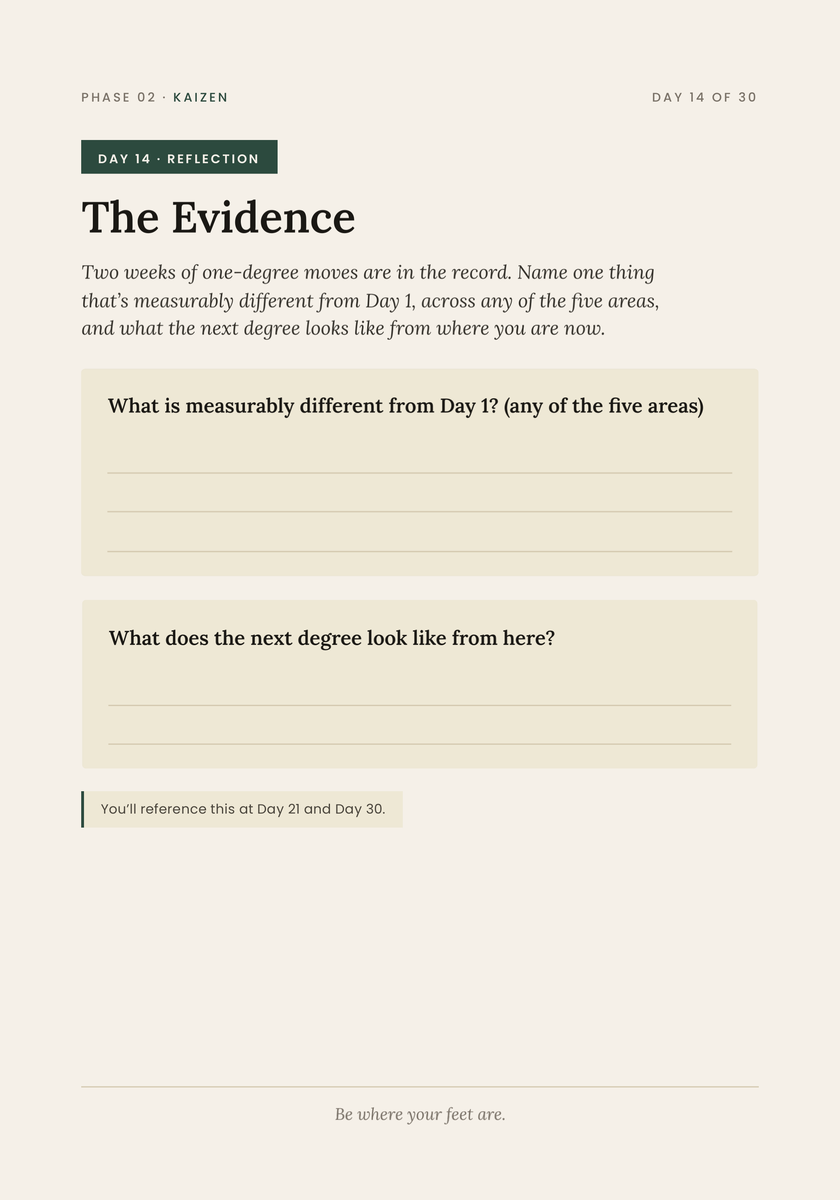
Start the plan. Give it a real two weeks — enough to feel whether anything's shifting. If you get to day fourteen and it did nothing for you, write one line back and every cent comes back — no forms, no questions, no explaining yourself to anyone.
The risk is ours.
It was never you. You were using tools built for a life you don't get to live. This one was built for the one you have.
And you're not deciding to do thirty days tonight. You're deciding to open one.
Get the 30-dayrecovery plan$37